
Agility Is Not the Same as Motion
Oct 14, 2026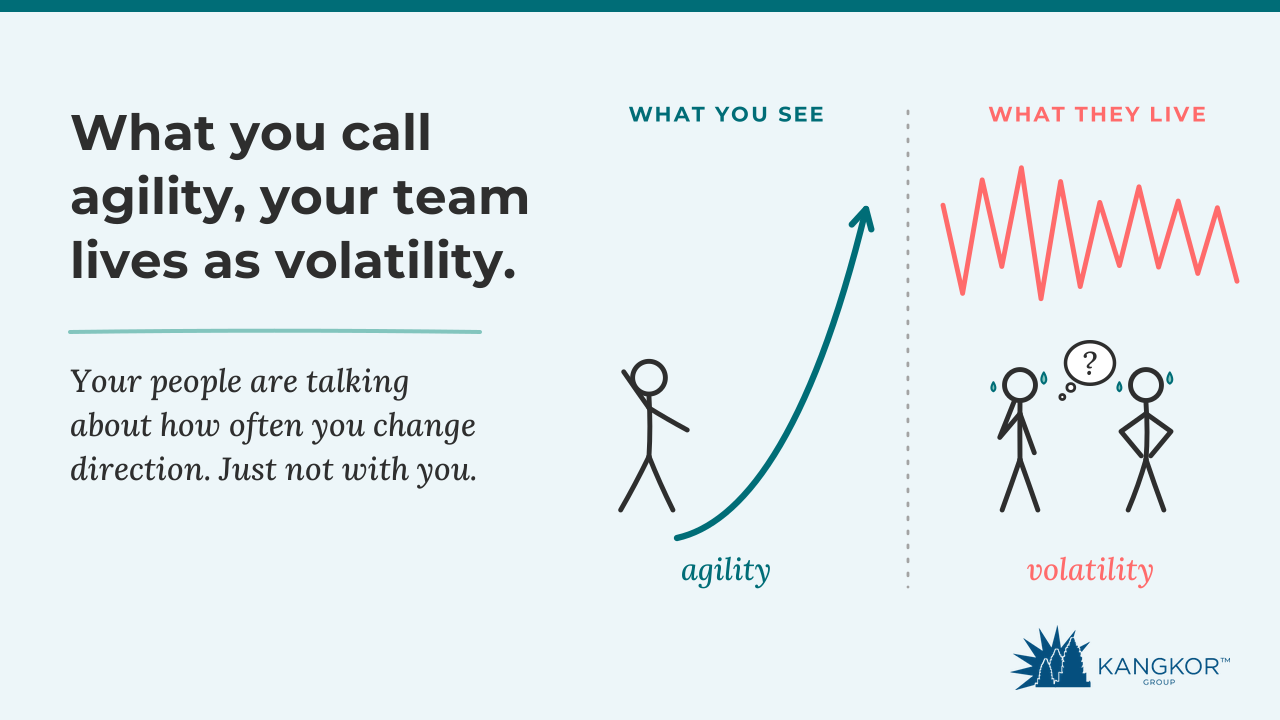
When the direction keeps changing, how do you tell a leader who is adapting from one who is simply moving?
In my last post, I wrote for the executive who sits one level below a leader whose direction keeps shifting. That piece grew out of a question raised in one of our Spark Circle™ Mastermind sessions. A senior executive described working with a founder who agrees to a commitment one week and reverses it the next. The founder has a vision, but no clear roadmap the team can follow.
This post is for the founder. From the top, the same pattern can feel like agility.
The Reversal That Saved the Bet
In 2011, Netflix announced a price increase and a new plan called Qwikster. Customers left. Netflix lost about 800,000 subscribers in the third quarter of that year. According to ABC News, the stock fell 74% from its $300 peak between July 13 and October 25, 2011.
Reed Hastings could have defended the plan. Instead, he reversed Qwikster, and he did it in public. "We moved too quickly," he said.
What makes this worth studying is not the mistake. It is how the correction was made. It was one decision, announced and owned, and the larger bet on streaming stayed in place. By the end of 2013, Netflix had passed 44 million members, according to the Motley Fool.
One turn. Named out loud. A core that held.
Keep those three in mind. They are the difference between a leader who adapts and a leader who simply moves.
Agility Is Not the Same as Motion
The case for change deserves a fair hearing first. Stability can be inertia with good manners. A leader who lets a weak plan run because changing it feels uncomfortable is not being disciplined. They are avoiding the job.
There is research on that side too. In a 1989 study of eight microcomputer firms, Eisenhardt found a strong link between decision speed and performance; the slow deciders failed or did poorly.
Look closely at who won, though. The fast deciders also tied their decisions to one another and worked from real-time information. They were fast and coherent, which is the opposite of a rollercoaster.
The closest research on frequent strategic change points the same way. Chatterjee and Hambrick studied 111 CEOs of software and hardware companies (Administrative Science Quarterly, 2007). The CEOs they rated most narcissistic changed strategy more often and made bigger bets. Their results swung higher and lower than their peers'. They did not produce better results on average.
Hold that study loosely. It measures narcissism through indirect signals, it covers one industry, and the data is nearly twenty years old. But the signal is clear: frequent change buys you variance, not results.
I have come to see that the leaders who changed course and won had three things in common:
- The reversal was singular. One decisive turn, not a series of them.
- It was named and owned. People knew the old direction was finished.
- A core held still. Brad Stone's reporting on Amazon describes Bezos pushing hard tactical swings, including a $120 million toy push he later backed away from, around a strategy that did not move.
The setting mattered too. The cases that worked were survival moments or fast-moving markets. Tesla in late 2008, with about $9 million on hand according to CNN's timeline, was fighting to stay alive. In a business where results come from doing the same things well, day after day, constant change is at its most expensive.
One more distinction helps: temperament and direction are not the same thing. A leader can be intense and demanding and still hold a steady course.
Harshness does not buy an edge on its own. A study published in PNAS in 2020 followed 457 people for about 14 years. It found that disagreeable people did not rise to power faster: what they gained through intimidation, they lost through poor relationships.
Still, most of the damage comes from direction, not tone. When priorities keep turning, teams tend to stop owning their work and start waiting for the next instruction.
The Big 5 of Strategy, developed by Strategy.Inc, names Adapt to Change and Deliver the Results as separate competencies. The way I read it, volatility has a place in the first and does real harm in the second.
Volatile at the edge, stable at the core.
A Test Before Your Next Turn
If you are the one setting direction, three practices help this week.
1. Run the reversal test. Before you change a priority, ask one question: is this a single correction I will announce, own and hold for 90 days, or is it another turn? If it is a correction, make it fully. If it is another turn, ask what it would replace and whether it can wait.
2. Name your fixed core, out loud. Write down two or three things that will not change for the next 90 days, and tell your leadership team. Let your energy for change work outside those lines, not across them.
3. When you do reverse, say so. Name the old direction, say why it is ending, and say what stays the same. Your team should never have to guess whether last week's commitment still stands.
Your team should never have to guess whether last week's commitment still stands.
Your Dare This Week
Before Friday, ask your leadership team one question about yourself: "Name the last reversal I made. Was it a correction or a turn, and how did you know?"
Then listen. Don't explain, defend or correct. Their answer will tell you more about your strategy than your plan does.
Here is my question for you: what is one thing you have held fixed while everything else around it changed, and what did it do for your team? Share it in the comments. Someone reading this may need your answer.
If this dare touches something you are working through right now, let's talk it through together.
Love be with you. Lead on with purpose, grace, and limitless potential.
©️Tito Kang 2026
Sources
- "Making fast strategic decisions in high-velocity environments," AcaWiki summary of Eisenhardt, Academy of Management Journal, 1989. https://acawiki.org/Making_fast_strategic_decisions_in_high-velocity_environments
- "New study measures narcissistic CEOs' effect on corporate strategy," Phys.org, July 2007 (summary of Chatterjee and Hambrick, Administrative Science Quarterly 52(3)). https://phys.org/news/2007-07-narcissistic-ceos-effect-corporate-strategy.html
- "Being a selfish jerk doesn't get you ahead," ScienceDaily, August 31, 2020 (Anderson, Sharps, Soto and Keltner, PNAS). https://www.sciencedaily.com/releases/2020/08/200831154408.htm
- George Anders, "Bezos In Action: 10 Zesty Slices From Brad Stone's New Book," Forbes, October 15, 2013. https://www.forbes.com/sites/georgeanders/2013/10/15/bezos-in-action-10-zesty-slices-from-brad-stones-new-book/
- "The history of Tesla and Elon Musk," CNN, March 2019. https://edition.cnn.com/interactive/2019/03/business/tesla-history-timeline/index.html
- "Netflix Stock Plunges After 800,000 Members Quit," ABC News, October 25, 2011. https://abcnews.com/Technology/netflix-earnings-stock-drops-800000-members-quit-online/story?id=14809394
- "How Netflix Recovered From the Qwikster Debacle," Motley Fool, March 27, 2014. https://www.fool.com/investing/general/2014/03/27/how-netflix-recovered-from-the-qwikster-debacle-an.aspx
LIMITLESS LEADER

TITO KANG
