
Eisenhower Never Drew the Matrix. Here's What He Actually Said.
Oct 08, 2026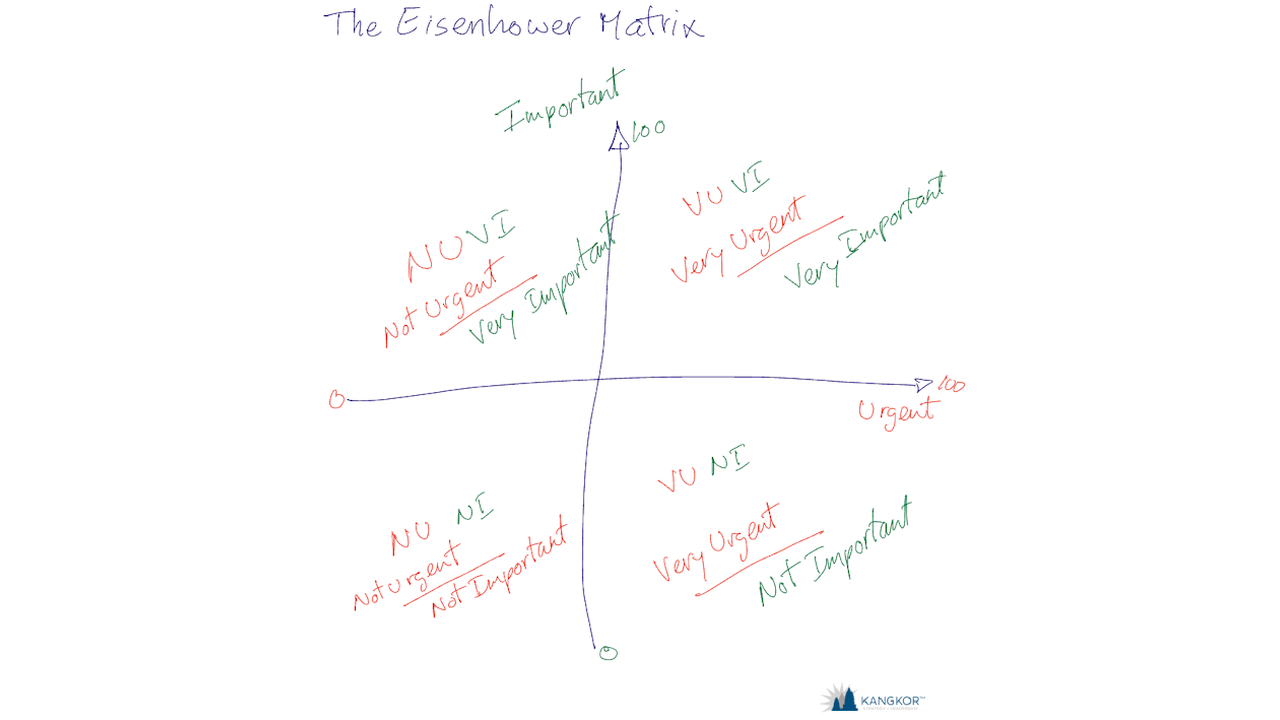
By Monday morning, you know what matters most this quarter.
By Thursday, a customer complaint, a late shipment and an open position have taken the week. None of them were wrong to handle. And the thing that mattered most is still sitting exactly where you left it.
If that sounds familiar, you are in long company. In 1954, speaking in Evanston, Illinois, Dwight D. Eisenhower quoted a former college president: "I have two kinds of problems, the urgent and the important. The urgent are not important, and the important are never urgent."
That line later became a four-box grid on whiteboards everywhere. Eisenhower never drew it. Stephen Covey built the matrix in 1989 and named the important-but-not-urgent box Quadrant II. The grid is useful. But it leaves out the most practical thing Eisenhower said that day. We will get to it.
First, a factory in Missouri.
Nine million dollars and a weekly huddle
In 1983, International Harvester was about to shut down its remanufacturing plant in Springfield, Missouri. Jack Stack and 12 other managers decided to buy it on behalf of the employees, for $9 million.
By SRC's own account, in the first month after the purchase they had no money, no outside resources and 119 people depending on them. The company says the owners were scared, and that they knew they could not rely on traditional ways of managing.
What they built was not a thicker strategic plan. It was a rhythm. Staff gathered at least weekly in what they called a huddle, a word chosen to evoke game strategy, to go through the financials and what those numbers suggested doing next.
Think about what that huddle did. Every week, the important work got a time, a place and an audience. It could not quietly wait for a calmer month, because the next huddle was always a few days away.
SRC grew into a group that, according to the company, includes ten businesses with sales nearing $1 billion and more than 2,000 employee-owners. Stack told the story in The Great Game of Business, written with Bo Burlingham and published in 1992. I will not pretend one meeting explains all of that growth. But a team with less slack than almost any of us chose rhythm as its first tool, and kept it.
I have faced the same choice. We were under pressure to meet our sales objectives, and the measure we were given was more prospecting. It was very urgent and very important.
I decided to take a step back. With the team, we completed a SWOT for the region. We met with clients and prospective clients, not to sell, but to understand the challenges in the industries they served. We read trade journals to confirm what we heard in those interviews and to look for blind spots.
We looked at the very important with urgency, not the very urgent that was thrust upon us.
It was uncomfortable. We had to justify why we did not meet the immediate results expected. But after 90 days, the results showed up. We grew the business by more than 30% a year, compounded, for three straight years.
Strategy rarely fails in the boardroom. It fails in the hundred reasonable decisions made the week after.
Why good leaders drift
I have come to learn that drift is rarely a character flaw. It is how attention works.
In 2018, researchers Meng Zhu, Yang Yang and Christopher Hsee ran five experiments and found that people chose tasks with objectively lower payoffs when those tasks merely looked urgent, for example when they carried an illusion of expiring. According to Johns Hopkins University's coverage of the study, people who described themselves as busy were more prone to it.
Two weeks ago, on 18 September 2026, an independent team at the University of Nottingham published a replication with 2,374 participants. The effect held. It was smaller than first reported once other explanations were controlled for, and it was measured on lab tasks, not in boardrooms. That honest caveat makes the finding more credible, not less.
Real leaders show the same pull. Michael Porter and Nitin Nohria tracked the time of 27 CEOs of very large companies, averaging $13.1 billion in revenue, and reported in 2018 that about 36% of their time went to reacting to issues as they unfolded. Actual crises took only 1%. Most of the reactive time was ordinary business that simply arrived with a clock attached.
Meetings follow the same pattern. In a 2004 survey of 187 large companies, Michael Mankins found leadership teams spent about 21 hours a month in meetings: 18 on operations and about 3 on strategy.
Now the fair case against everything I have just said. If you own a $30 million manufacturer and also run its operations, urgent work is not a distraction from your job. It is your job. A 2020 study of 1,114 CEOs in six countries by Oriana Bandiera and colleagues found that CEOs who spend their time close to core functions are not worse for every firm; what matters is the fit between the leader and the company. So the goal is not to escape the urgent box.
The problem is narrower, and easier to fix. Important work has no appointment, so it loses by default.
I could not find research that tracks important work turning into urgent work inside a company, so take the drift as an argument, not a finding. But the edges of it are visible. In a 2024 Gallup survey of recent voluntary leavers, 42% said their departure could have been prevented, and 45% said no manager or leader had discussed their job satisfaction, performance or future with them in the three months before they left. (Gallup sells manager development, so read it with that in mind.) A conversation that was never urgent became a resignation that was.
This is where Eisenhower's forgotten line comes in. Right after the famous one, he said the gathering could help place the important before us and perhaps even give the important "the touch of urgency."
That is the whole job. Not choosing a box. Giving the important a deadline before the calendar gives it one for you.
Three ways to give the important a deadline
1. Separate the strategy meeting from the operations meeting. This was Mankins's first recommendation. When both share an agenda, the operational items win, because they are louder. He pointed to ABN AMRO, which split the two and spent more time on strategy while cutting total meeting hours.
2. Break each priority into milestones due within 30 days, each with one owner. Zhu's own suggested remedy for urgency bias was to break big projects into smaller tasks with near deadlines. A strategic priority due "this year" will lose to a shipment due Friday. A milestone due on the 28th has a fighting chance.
3. Write progress down and report it to someone. A 2016 meta-analysis of 138 experiments by Benjamin Harkin and colleagues found that monitoring progress more often improved goal attainment, and the effect was larger when progress was recorded and reported to others. Most of those studies tested personal goals, not company strategy, but the mechanism travels. And when you review, ask two questions, not one: "Are we on track?" and "Is this still the right priority?" Strategy researchers Donald Sull, Rebecca Homkes and Charles Sull have argued that execution means adapting as conditions change, not just sticking to the plan.
Then sit with one more question: between planning sessions, who drives follow-through on your plan?
If the honest answer is "me, on top of everything else," notice that the research points straight at that spot. Busy people are the most prone to urgency. Progress holds best when it is reported to someone outside your own head. The framework is simple. Holding it, week after week, while running the business, is the hard part.
The framework is simple. Holding it, week after week, is the hard part.
This week's dare
This week, put one 60-minute strategy block on the calendar, separate from your operations meeting, and protect it the way you would protect a visit from your biggest customer.
Bring one priority. Leave with one milestone due within 30 days, one owner, and one person who will hear how it is going.
That is your first huddle. SRC started with less.
When did an important priority last turn into an urgent one in your business, and what would have caught it earlier? Share it in the comments; your answer may be exactly what another leader needs to read.
If you want an honest picture of where your own rhythm stands, the Execution Gap Check takes about six minutes. You will get a score out of 100 and a breakdown across Clarity, Alignment, Accountability and Rhythm.
Love be with you. Lead on with purpose, grace, and limitless potential.
© 2026 Kangkor Group. All rights reserved.
Sources
- Dwight D. Eisenhower, Address at the Second Assembly of the World Council of Churches, Evanston, Illinois, 19 August 1954. The American Presidency Project. https://www.presidency.ucsb.edu/node/232572
- Quote Investigator, "What Is Important Is Seldom Urgent and What Is Urgent Is Seldom Important," 9 May 2014. https://quoteinvestigator.com/2014/05/09/urgent/
- FranklinPlanner blog, on Stephen R. Covey, The 7 Habits of Highly Effective People (1989), Habit 3. https://blog.franklinplanner.com/?p=886
- Springfield Business Journal, "No. 9: SRC takeover." https://sbj.net/stories/no-9-src-takeover,23632
- Great Game of Business, "About Us." https://www.greatgame.com/about-us
- strategy+business, "Jack Stack's Story Is an Open Book." https://strategy-business.com/article/20088
- SRC Holdings, "Jack Stack" (bio). https://www.srcholdings.com/bio/jack-stack
- Meng Zhu, Yang Yang and Christopher K. Hsee, "The Mere Urgency Effect," Journal of Consumer Research 45(3), 2018. https://academic.oup.com/jcr/article-abstract/45/3/673/4847790
- Johns Hopkins University Hub, "How misperceptions of deadlines, urgency influence time management and performance," 31 May 2018. https://hub.jhu.edu/2018/05/31/meeting-deadlines-time-management-behaviors/
- Richard Mills, Robin Cubitt and Chris Starmer, "Brief Commentary: An Independent Replication Study of the Mere Urgency Effect," Journal of Consumer Research, 18 September 2026. https://academic.oup.com/jcr/advance-article-abstract/doi/10.1093/jcr/ucag026/8817231
- Michael E. Porter and Nitin Nohria, "How CEOs Manage Time," Harvard Business Review, July to August 2018. https://hbr.org/2018/07/how-ceos-manage-time
- Michael C. Mankins, "Stop Wasting Valuable Time," Harvard Business Review, September 2004, summarised in Stanford Social Innovation Review, Spring 2005. https://ssir.org/articles/entry/how_to_waste_time_and_lose_sight_of_priorities
- Oriana Bandiera, Andrea Prat, Stephen Hansen and Raffaella Sadun, "CEO Behavior and Firm Performance," Journal of Political Economy 128(4), 2020. https://researchonline.lse.ac.uk/id/eprint/101423
- Corey Tatel and Ben Wigert, "42% of Employee Turnover Is Preventable but Often Ignored," Gallup, 9 July 2024, updated 16 February 2026. https://www.gallup.com/workplace/646538/employee-turnover-preventable-often-ignored.aspx
- Quartz, "How to manage your time better by fighting urgency bias," July 2018. https://qz.com/work/1331152/how-to-manage-your-time-better-by-fighting-urgency-bias
- Benjamin Harkin et al., "Does Monitoring Goal Progress Promote Goal Attainment? A Meta-Analysis of the Experimental Evidence," Psychological Bulletin 142(2), 2016. https://eprints.whiterose.ac.uk/91437/
- Donald Sull, Rebecca Homkes and Charles Sull, "Why Strategy Execution Unravels, and What to Do About It," Harvard Business Review, March 2015.
LIMITLESS LEADER

TITO KANG
